Virtual Reaction Game — developing brave new worlds
You are suddenly riding around Stanford in an Aston Martin convertible. 3D text appears in front of your car with game instructions and a countdown timer. Ringing bombs spawn all around you; you must locate and defuse them! If you run out time, you should restart the level… or continue playing amongst colorful exploding bombs which will certainly induce nausea.
This truly describes the premise and experience of Virtual Reaction, an immersive Virtual Reality (VR) game. My team created this interactive training game to improve a user’s sensory processing and reaction times. We hypothesize that Virtual Reaction maximizes users’ stimuli and engagement which results in better training and more fun.
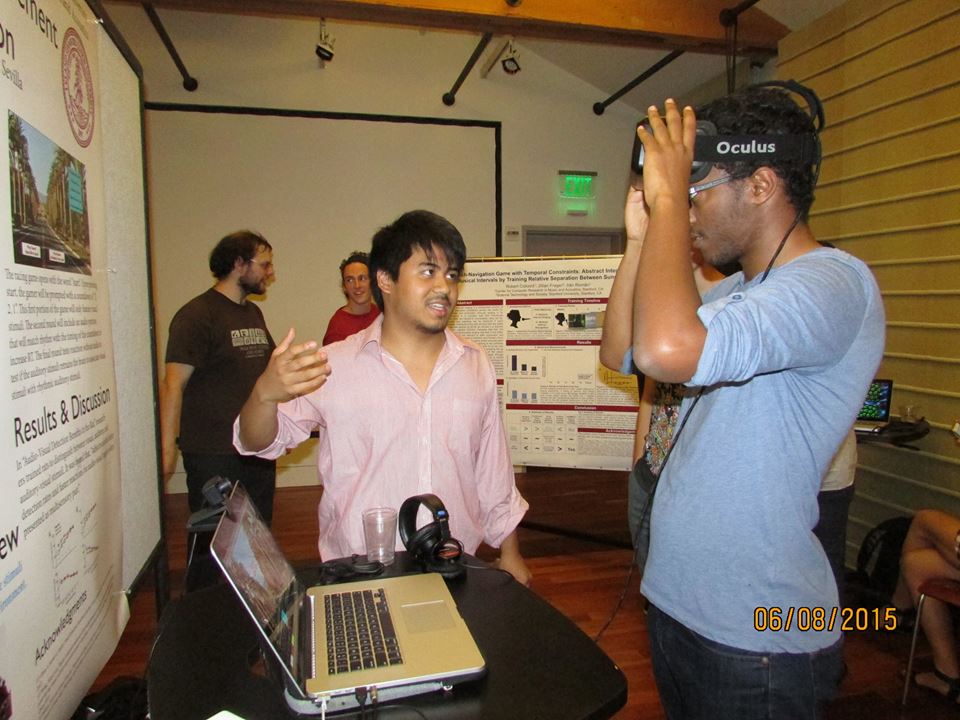
Explaining Virtual Reaction to my friend at the Synapse Arcade. He was the first of only two people to beat the game’s hard level!
New Skills:
- Unity 5 Game Engine. Javascript/C# scripts
- Developed VR environment with Oculus Rift DK2 featuring live-action footage
Next Questions: During the game’s development, I encountered 4 salient problems that I think epitomizes VR’s biggest challenges:
- Lagging Frame Rate: Our game needed to be more efficient with its computation. There was noticeable lag when changing your view.
- Un-immersive Sound: multi-sensory integration is essential to make our surroundings believable. Our game featured background music, driving/car/wind sounds, and ringing bombs in 3d space. When mixed together, the sound wasn’t convincing.
- Unreal interactive experience: without Oculus Touch, input was constrained to computer keys. Typing does not translate into VR well so users may feel disoriented trying to interact with the game.
- VR sickness: the 3 previous issues and several other factors caused discomfort for users. Being in VR is always fun, however during its development I required frequent breaks in order to rest my eyes and keep my dinner inside me.
Key Takeaway: VR will disrupt, enhance, and redefine how we consume media. Applications are everywhere: gaming, cinema, training, research experiments, surgery, defense, communication, and a lot more. Right now, it’s a young evolving platform that’s experiencing significant growing pains. But I believe it’s only a matter of time before people overcome these challenges and unlock VR’s potential.
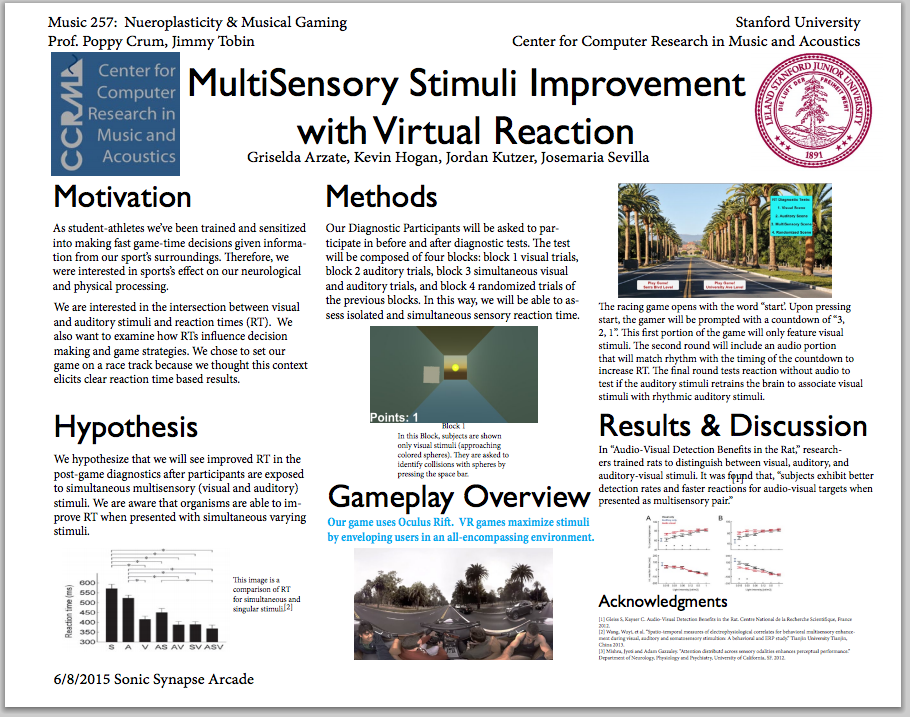
Our poster explains the basis of the VR game as a neuroplastic training environment.
 Starting
Leave a comment